After spending $45 and a half day drive on a quart of brand name chalk paint, I was determined to find the BEST Homemade Chalk Paint Recipes for a cost efficient alternative.
If you’re interested in mixing your own chalk paint to save yourself time and money, read on because I discovered a bunch of interesting stuff I wasn’t made aware of on other blogs.
I tried four (4) of the most popular Homemade Chalk Paint Recipes and the results surprised me and left me with a hands-down fave! In sharing my experience, I hope it helps you decide which DIY recipe is right for you.
So let’s start my countdown…. 😉
 Baking Soda Recipe

2/3 cup Paint
1/3 cup Baking Soda
Mix really well
My least favourite is the baking soda recipe.
When applying this Homemade Chalk Paint, (HMCP) it had a very gritty texture despite a thorough mixing. I could actually see the tiny granulars in the paint as I was applying each coat.
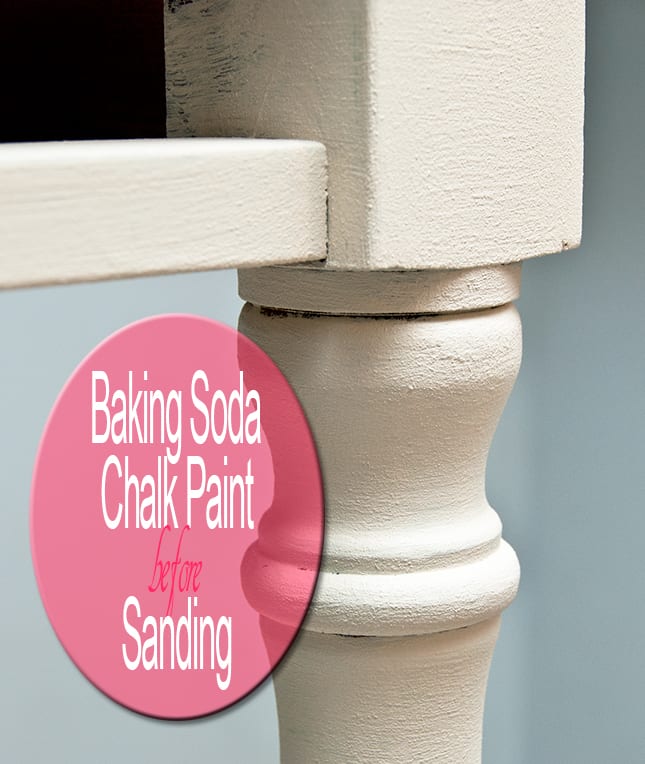
I was worried it wouldn’t sand down properly, but it turned out just fine…. whew! Here’s what it looks like after the final sanding/distressing.
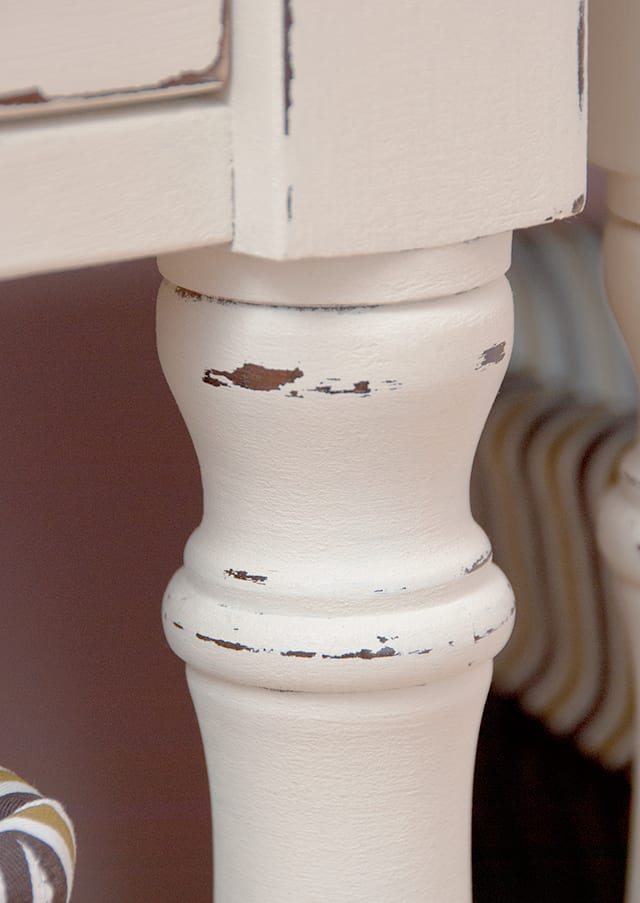
Although Baking Soda Chalk Paint is listed last on my countdown, it’s perfect if you’re trying to achieve an old weathered, distressed “country” looking piece of furniture.
Deana at Alchemy Fine Living has a great video showcasing a dresser painted with the Baking Soda Chalk Paint Recipe.
Baking Soda Chalk Paint Cost – $1.69 for a box of baking soda which can be used for another 5 single chalk paint recipes + cost of latex paint
Time Involved – No time was spent on the purchase because I always have baking soda in my kitchen. 2-3 minutes to mix it thoroughly into the paint.
Application – Grainy look and feel even when mixed thoroughly.
Adhesion & Coverage – Great! No priming or sanding required and great coverage. Good coverage after 2 coats but I applied 3.
Odour – No odour other than the latex paint it’s mixed with.
Clean Up – Cleans up like regular latex. Not as easy as 100% green brand name chalk paint.
Distressing – Requires sanding. Not as effortless as brand name chalk paint (ie distressing with dampened cloth).
Finish – The finished look is chalky but not quite as smooth as brand name chalk paint.
 Non-Sanded Grout Recipe

1 cup Paint
2 Tbsp Unsanded Grout
Water to mix Grout
Number 3 on my list is the Unsanded Grout Recipe.
I mixed the grout with the water, then once smooth, added it to the paint. It looked and applied like a brand name chalk paint. It dried fast (within 1/2 hour), and the finish was just as “chalky” as the store bought.
It had a bit of a weird odour…ok…really weird. But because it was applying so beautifully, I wasn’t bothered by it too much.
Fabulous! … so why is it listed No.3 on my list?
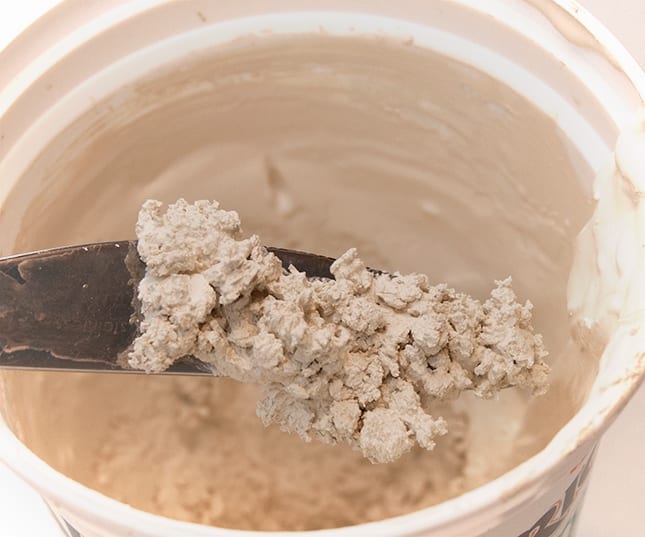
This DIY Homemade Grout version started to thicken up while I was applying my first coat…. it turned more like thick icing than paint.
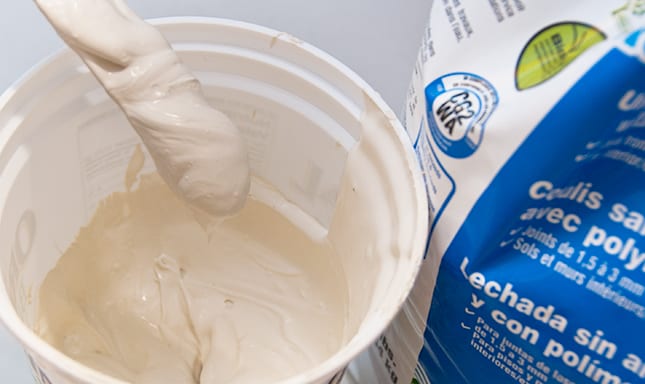
I had to keep mixing it while I was painting and eventually had to add more water because it was too thick. The next day it had really congealed and more water was needed. Take a look… it just kept turning into a thick mess!
Here is the before and after. The table on the left is painted with Baking Soda HMCP and the table on the right is painted with Unsanded Grout HMCP. Can you see a difference?
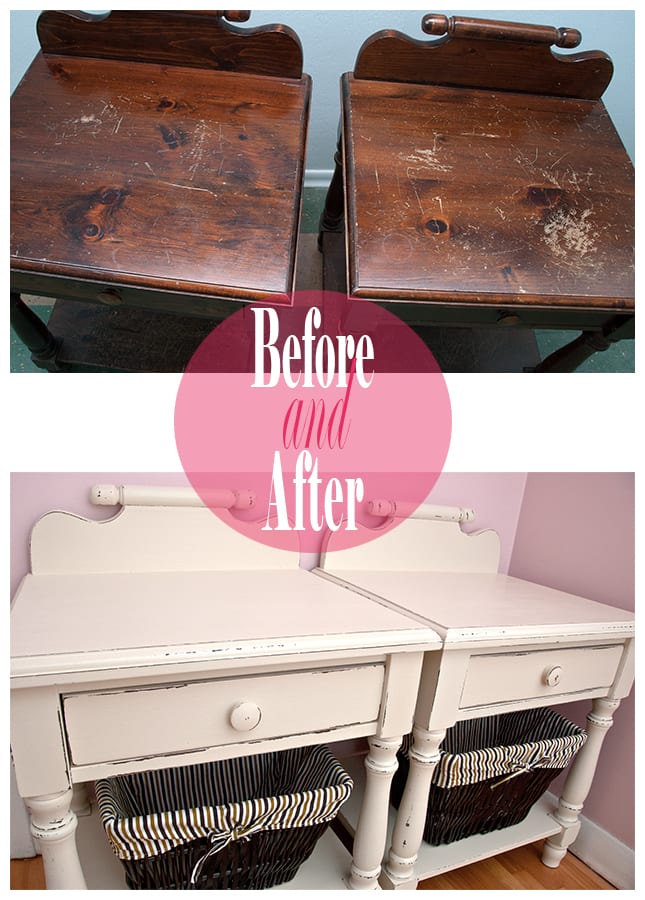
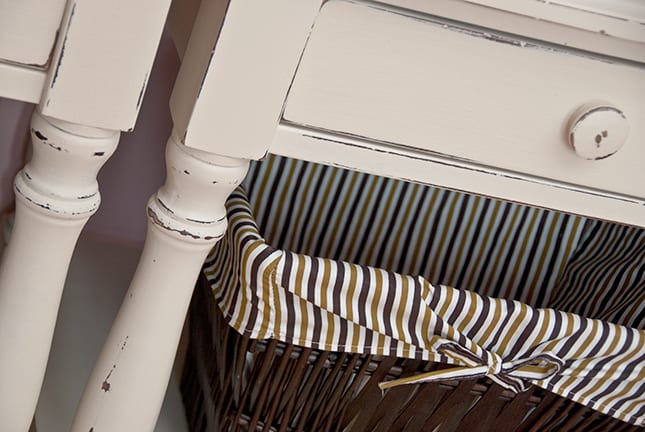
Unsanded Grout Chalk Paint Cost – $17.99 for a large 10lb bag which will last a zillion single recipes + cost of latex paint
Time Involved – Easy to find Non-Sanded Grout on-line or at any Lowe’s, Home Depot, Rona, Canadian Tire or any on-line home reno store. Note – Grout comes in different colours. You want to buy white unsanded grout. Why? If you add a coloured grout to your paint, it may alter your paint’s hue. 3-5 minutes to measure and mix it thoroughly into the water and paint.
Application – Fabulous… until it started thickening up. Then time was spent mixing it and adding additional water to obtain the right consistency.
Adhesion & Coverage – Great! No priming or prep required and it had full coverage after 3 coats. The more water I added, the thinner the coverage.
Odour – It had a weird smell. I’d love to explain it to you but I don’t know what to compare it to?
Distressing – Requires sanding. Not as effortless as with a brand name chalk paint (ie rubbing with dampened cloth).
Clean Up – Cleans up like regular latex (brand name chalk paint cleans up much easier)
Finish – The finished look is exactly like a brand name chalk paint. Smooth, chalky and lovely.
 Plaster of Paris Recipe

3 parts Paint
1 part Plaster of Paris
Water to mix
My number 2 pick is the Plaster of Paris recipe.
I made a smooth paste with the plaster of paris and water before mixing it into the paint. When mixed well, it was silky smooth and applied just as nicely as brand name chalk paint. 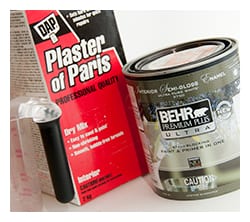
The second day it did thicken a little and appeared a little grainy, but after a thorough mixing it was fine.
The left over paint was stored in a glass pickle jar and used again 2 weeks later.
Plaster of Paris Chalk Paint Cost – $6.oo for a large box which will last for a looong time + cost of latex paint
Time Involved – Easy to find Plaster of Paris on-line or at any Lowes, Home Depot, Rona, Canadian Tire or craft store. 3-5 minutes to measure and mix it thoroughly into the water and paint.
Application – Fabulous! The consistency was great and it applied like brand name chalk paint.
Adhesion & Coverage – Great! No priming or prep required. Applied 3 coats for compete coverage.
Odour – None other than the latex paint used.
Distressing – Requires sanding. Not as effortless as with a brand name chalk paint (ie rubbing with dampened cloth).
Clean Up – Cleans up like regular latex (brand name chalk paint clean up is much easier)
Finish – The finished look is exactly like a brand name chalk paint. Smooth, chalky and lovely.
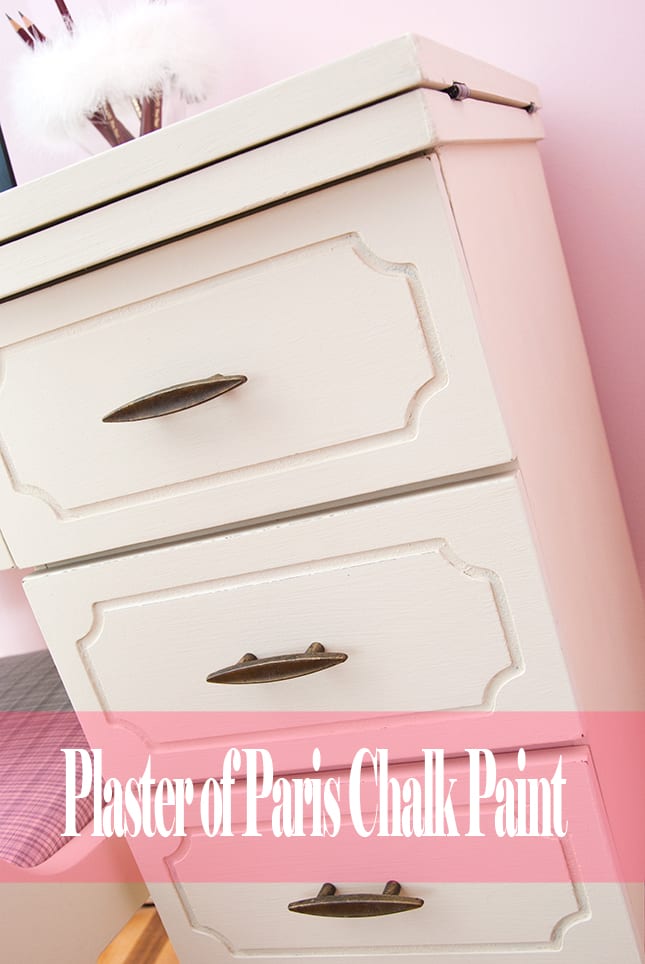
I used the Plaster of Paris Chalk Paint Recipe to re-purpose an old sewing table into a little girl’s desk. What do you think?
 Calcium Carbonate
2 parts paint
1 part Calcium Carbonate
My hands down #1 choice was the Calcium Carbonate Recipe…which makes good sense since Calcium Carbonate is chalk!
It mixed into the paint easily, had the perfect consistency, coverage was fantastic, dried within 30 minutes, AND left me with a perfect chalky finish. I stored the left over paint in a yogurt container and it kept the same consistency for days. (I did stir it vigorously each time before use.)
The only downfall to my #1 choice was I had a difficult time finding it! Not many stores sell it in powder form and the pill form won’t work even if you grind them up.
My local pharmacy ordered it in for me and I picked it up 4 days later. Since then, I’ve found a good grade Calcium Carbonate On-line and will be ordering from the comfort of my home. 🙂
As I mentioned above, the Plaster of Paris recipe was used to re-purpose the sewing table into a desk, but I used the Calcium Carbonate Chalk Paint to paint the matching chair. Can you tell the difference?
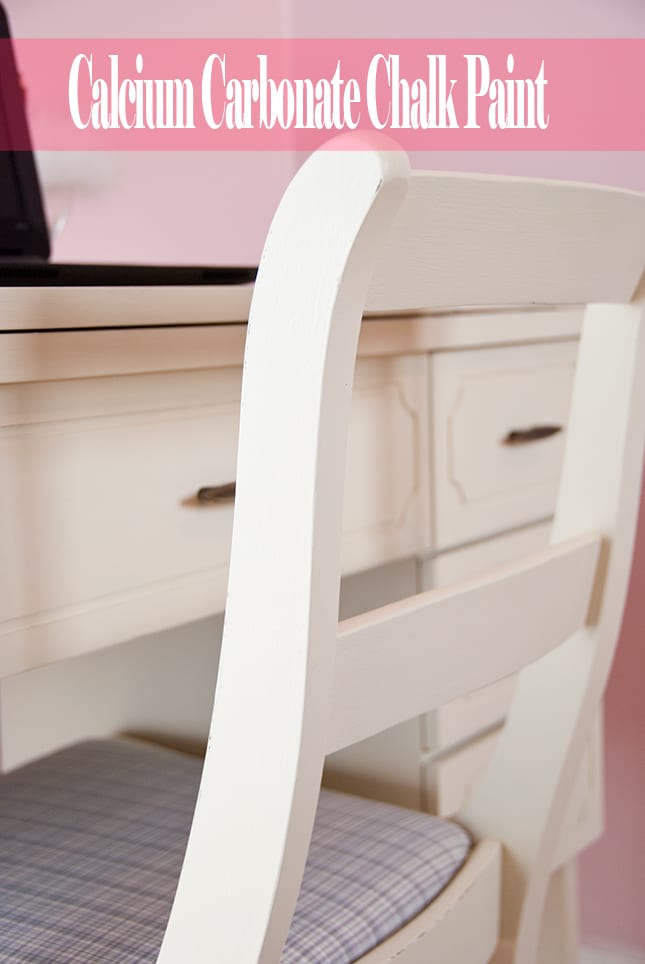
Calcium Carbonate Chalk Paint Cost – $11.99 for a 500g container which I’m almost finished. I’ve painted 1 chair, a large desk (NOT the one shown above) and 2 large chalk board frames. I have enough left over for another small/medium project. Out of all four(4) recipes, Calcium Carbonate is the least economical. However, comparing it to brand name chalk paints, the cost difference is still pennies on the dollar in this recipes favour! + cost of latex paint
Time Involved – Took me 2 weeks to track this stuff down! I searched Shoppers Drug Mart, Health Food Stores, Organic Stores and finally asked at my local pharmacy. Next time, I’ll be ordering it on-line! 3-5 minutes to measure and mix it thoroughly into the paint.
Application – Fabulous…exactly like brand name chalk paints.
Adhesion & Coverage – Great! No priming or prep required and the coverage was fantastic. It dried faster than the Plaster of Paris (within 20 minutes) because no water was added.
Odour – None, other than the latex paint used.
Distressing – Requires sanding. Not as effortless as with a brand name chalk paint (ie rubbing with dampened cloth).
Clean Up – Cleans up like regular latex (brand name chalk paint clean up is much easier)
Finish – The finished look is exactly like a brand name chalk paint. Smooth, chalky and beautiful!
So the Best Homemade Chalk Paint Recipe… Calcium Carbonate!
Although these HMCP recipes are not 100% green, the coverage and finish are VERY comparable to brand name chalk paints. In researching all my options, I also learned Wall Texture, Limestone and Whitening Powder can be used to make chalk paint.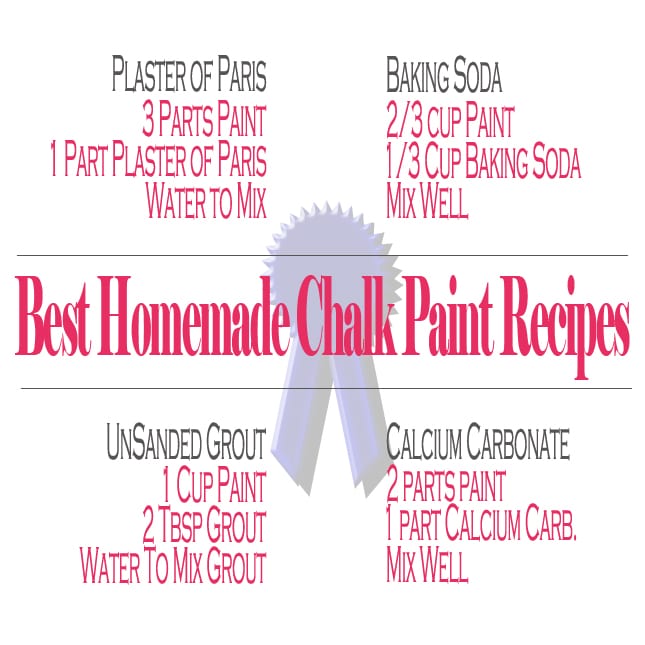
I wish I knew who to give credit to for the above recipes. Whoever originally came up with them… thank-you… absolutely BRILLIANT!!!!
Still undecided which DIY recipe you’re going to try? You can read more HMCP Tips here.
If you have a HMCP experience you’d like to share or have any questions, feel free to leave a comment and I’ll get right back to you!
Enjoy your day & happy painting.
Denise
 Hello again... I'm so happy you dropped by! Let's keep in touch! Follow me on social media or sign up for a dose of furniture painting inspiration and diy tutorials. :)
I work in a paint store and would like to make a couple of observations: Varathane is a particular brand of polyurethane and not a different product, polyurethane also can be had as a water-based product (Varathane brand or Minwax Polycrilic) which are not supposed to yellow. Also, there is now on the market a soy-based varnish that is supposed to be clear with no yellow cast. You might have to track it down at a specialty woodworking store. This is just a guess, but since the two primary ingredients that give latex paint body are titanium dioxide and chalk (calcium carbonate) the Valspar paint may have more chalk in it to begin with and may be what causes the problem. Again, this is just a guess! Thanks for all the interesting info.
Thanks for YOUR interesting info Sandy! I haven’t heard of a soy-based varnish but would like to give it a try!
I want to try this! Questions: Latex Paint, I’ve seen interior or exterior, water or oil base. Which one? What is the best wax to use to just give a protective coat? ty
Ruth, Interior latex water based paint with a flat finish works the best. I often use Minwax Furniture Paste for a wax finish but there are MANY fabulous brands on the market. Have fun!
Thank you for your reply. Going to try this tomorrow on a bench.
Exciting… have fun!
I have been using the grout recipe and in small projects it works great for me. I am trying to finish a long bench to put on my porch. We have some harsh weather in Indiana and I intend on coating it with Poly. I loved reading through your blog and it gave me a lot of ideas. I am interested in the corn starch recipe when I find it. The grout is fine for outside or small projects that I can sand down outside, but I have some projects that need a smoother finish. Thank you for taking the time to do this blog and testing. And then sharing your work results. A wonderful thing to do for we struggling artist. I am on my way out to the barn to start on my bench and then wax another one. I am hoping the cooler weather will not effect the results eg. drying time and thickening of my paint. Thanks again. Susan
Susan, I’m very curious about the cornstarch recipe as well. If you try it before me…please let me know how it works for you! Best of luck with your bench… I’m sure it will turn out gorgeous!!
Hi Denise! Great blog post. Thanks! I was wondering what type of paint did you use with the plaster of Paris. I want to give my furniture an age look. Thanks you
Maddie, using a FLAT latex paint works best with all of the above DIY Homemade Chalk Paint recipes. I’ve used numerous brands~ ie BM,SW,Berh,CIL and even re-cycled paint and have had great success with all of them!
I’ve finally found my answer! Latex is UK emulsion!! (or here in Australia, yet another name). I’ve posted that question in a few places, even asking if it is the paint for walls or the paint for trim. I still couldn’t get an answer, so thank you, thank you, thank you
While looking for calcium carbonate online, I came across an article about using it to add to goat feed, so I started looking for feed stores in my area. Lo & behold, they carry it in like 50 lb. bags (or smaller)for a fraction of what the health food stores are charging – $8-10 for a 50 lb. bag!
Calcium carbonate powder either comes from ground limestone or ground oyster shells. Both are edible & safe, so they put it in animal feed to up their calcium intake (and humans can take it, too – thus the health food store offerings – same stuff.) I found it at Tractor Supply in 5-lb. bags for $5.99. (They also have it in 50-lb. bags for $8.99 – if you do A LOT OF PAINTING!)It may need a little further grinding with a mortar & pestle, but not much. It is also sold as organic fertilizer, so lawn & garden stores my carry it.
Hi, Denise as the painted furniture market is still growing we at FB Design59 have tried everything. If you have a sporting goods store around the calcium carbonate (marble dust) is actually sports field marking chalk. Its safe to the point of playing sports on and around for kids. Of course we always sand our projects outside or wear masks. The typical cost should be around 10$ a bag for 50lbs. Also we sometimes used sheet rock joint compound. This comes in a dry form in a bag for under 10$ at most home improvement stores. Nice info just adding to it. Keep it up 🙂
Hi thank you for the recipes! How do I add colors to each of the recipes? Also a bit confused on the wax, min wax works?
Cyndy, you purchase a paint in the colour of your choice and then simply add the chalking ingredient of your choice to your paint. Yes, Minwax works beautifully!
Hi,
Can you please tell me if the brush strokes will be visible?I like a very smooth shiny finish.I’m trying to paint my son’s nightstand in a dark blue or navy,maybe a little distressing too.Also,what kind of finish should I use,wax or poly?It’s a piece of furniture that will get a lot of “attention” from 2 young kids(we keep books and some toys in/on it),and would like something that will be easy to wipe (especially the kid’s spills).Thank you.
Ann, brush strokes may be visible using chalk paint. To eliminate or greatly reduce brush stroke, may I suggest a quality brush and sanding in-between each coat. I’ve also recently spray painted chalk paint for a flawless finish which you can see here http://goo.gl/yBiR8N . For a dark painted night-stand which will be getting ample “attention” (love the way you phrased that!) I would top coat with poly.
Thank you.Btw,love ur work.
Hi,
I was wondering if you could help me.
You mentioned finding Calcium Carbonate was a bit of a hassle to find.
I live in Dubai and currently traveled to Cape Town, South Africa to try and find this product. Its as if it doenst exist!!
I need something that will hold its form so i can sell it at a market. The Plaster of Peris i am told dries up quite quickly.
Is there anything else i could find easier that will hold consistency?
Lizzy, are you wanting to sell it at the market in powder form? If so, Plaster of Paris in a dry environment will keep it’s powdery texture indefinitely. (btw… I would LOVE to visit Dubai!!)
Hello, love your blogs! Would this work over a kitchen made of formica (ie durability, lasting power). So many thanks.
Hi Sue! If prepped, painted and sealed properly, YES…many people have used ASCP over Formica with gorgeous results. Thanks for reading!
Thank you so much for your reply. Does this mean that the ‘job’ ie formica needs to be treated like anything that is to be painted with normal paint eg lots of sanding etc. I was more meaning can I treat the formica like anything else that is painted in chalk paint eg hardly any prep. Don’t mean to sound lazy but that would be a huge expedition. So many thanks again.
LOL… not lazy, who has time to spare these days right?! “Technically” no sanding is required. You may want to do a little more investigating on Annie Sloan’s website. I believe she has information/sealing products for painting cupboards, door, floors etc. Would love to hear how it all turns out for you Sue!
Thank you so much Denise.
I’m just about to mix up my first batch of chalk paint and I’m very glad I found your recipes, thank you. I have some cornice plaster that actually came from a rubbish tip! I thought it might work so looked at the ingredients and it says it’s mostly calcium carbonate and it’s very fine and smooth so here goes!
Good luck Vivien… I hope it turns out fabulous! 🙂
Love all the comparisons of recipes. This summer at Green Garage Furniture in Wisconsin, we used a recipe of 1 part of joint compound with water to thin to a paint consistency, to 3 parts of paint. the ingredientsin joint compound that I have are water, limestone, expanded perlte, and minerals.
We were pleased with the outcome for the most part. It sometimes seemed a bit too chalky and required some sanding and smoothing, but the volume of paint we use makes buying name brands quite prohibitive.
I was going to try the plaster of paris today which consists of calcium sulfate, calcium carbonate and crystalline silica.
I think there are some joint compounds that have calcium carbonate in them as well. It’s fun no matter what.
I do struggle with waxing, though, and tend to use a sanding sealer and then a poly. Yes, it does yellow a bit.
I am a potter by trade. The cheapest place to buy calcium carbonate(also known as whiting) is at a pottery supply store. A fifty pound bag is about $15.00. You can usually buy smaller bags too.
This is for Manuela, looking for waxes in Montreal. Try PIORRA MAISON, in the Pointe Claire Village on Lakeshore Road. They sell Annie Sloan paint and waxes, offer courses, and sell finished pieces (You can see the different colours and get some ideas!).
hi thanks so much for all these recipes if you get what I mean looking forward to trying the plaster of paris and no preparation , from sunny england
Thanks for the post. I have not been able to find the waxes here in Montreal in any of the major hardware stores. Does anyone knows where to find waxes?
Hi Manuela. If you’re not opposed to purchasing on-line, you can find many great furniture waxes on Amazon.ca or Ebay!
merhaba ben istanbul dan yazıyorum harika olmuş çok beğendim
Hello Nihal from Turkey! I had to Google the translation but thanks for the compliment. I LOVE Istanbul. Visited with my sister a few years back and it’s a gorgeous city!
Denise:
Are you waxing over the calcium carbonate paint finish? My real question…..have you applied any type of poly over the paint/wax finish? I have not done much experimenting but I did read somewhere that the poly could cause SOME paint and waxed finishes to peel. I need a protective coat on my items….live with people that are HARD on furniture!!!
Thanks,
linda
Linda, I have waxed and I have applied Polyurethane. I’ve NEVER experienced peeling when using a Poly. However, I don’t use a poly finish on white or light coloured pieces. It can turn a slight yellow with age or heat so I only recommend it for darker chalk painted furniture. Another option for a hard surface finish is Varathane which also works great.
I didn’t read thru all the posts, so someone may have suggested this – A Friend of mine suggested a ceramics store. And we got the CC for a little over a $1 a lb and she said it mixes beautifully. I am trying tonight for the first time!
Can I ask why you don’t mix the cc with water first. Your recipe is the first I have seem that doesn’t use water. New to this so thanks for the info!
Hi Amy! If the finest grade of calcium carbonate is used, there is no need to mix it with water. The CC is so fine, it mixes into the paint beautifully, no lumps, no grit.If your friend suggests you mix a little water in with the CC she gets from the ceramic store, I would go with what has been tried and tested. 🙂 Hope your first project turns out gorgeous!!
hi denise
can you use the HMCP on a kitchen table and chairs,and can it just be waxed or has it got to have varnish,also could you tell me has it got to be sanded first please.As you probaly guessed this is my first project and i cant wait to have a bash at it.thank you
Yes, you can use HMCP on a kitchen table+chairs and it will look fabulous! If the table/chairs have a shiny surface, I would give it a light sanding prior to painting. Wax will work as a seal however if the table is high traffic ie hot/cold plates, sweating glasses etc, I would protect it with a poly or varnish. Good luck…I’d love to see how it turns out for you Denise. 🙂
One you may not be aware of is cornstarch as the addative. I’ve been using it after seeing it posted on pinterest. Does not harden, goes on beautifully, sands well. You may want to check it out !
Thank you Denise – and your use of ‘spot on’ was spot on! Hi Denise Barber – I’ve just ordered 1kg of calcium carbonate (described as fine food-grade powder) on Amazon. It’s £5.52 including delivery. There are a couple of reviews from people saying they’ve used it to make chalk paint and reporting excellent results. amazon.co.uk/gp/product/B00CWMA702/ref=oh_details_o01_s00_i00?ie=UTF8&psc=1
or just type ‘calcium carbonate powder’ into the Amazon search. There was also some listed on ebay.
I’ll report back when it arrives on what volume 1kg represents – i.e. how much paint will it ‘transform’! – and also on results, hopefully.
thank you so much emma.x
Thank you for sharing all your recipies and knowledge. Hmcp is a great option for anyone where budget is a concern and for those who simply prefer to make their own chalk paint. You are so right, chalk is just calcium carbonate!
This is really useful and inspiring, thank you. Can’t wait to try. I’d also imagine that while mixing, you could customise the colour to your heart’s content! I use ‘tester bottles’ of emulsion (‘latex’) paint in strong colours, and/or craft-shop acrylic paint to create / adjust the colour. (Just make sure what you’re adding is water-based). A cheap bendy silicone kitchen spatula is very useful for mixing, and for transferring paint without wasting any.
For UK / European readers like me, just to confirm what you have said, for home made chalk paint you use any emulsion paint(the ordinary ‘walls and ceilings’ paint that comes in loads of colours), preferably in matt finish. The measures are by volume, so for a 2.5 Litre tin of paint, you need to add 1.25 Litres of calcium carbonate powder. It’s fine to measure this by pouring the powder into a kitchen jug – calcium carbonate is edible (in moderation!) Any soft beeswax furniture polish should work as a top coat. I love beeswax balsam (comes in a glass jar – I got it at Sainsbury’s) which smells gorgeous.
Welcome Emma from the UK!! Yes, Yes and Yes!… you’re spot on Emma (I’m trying to use a UK expression) 😉
hi emma your post is just what i was looking for, someone from the uk to translate the usa ingredients,could you tell me where you get the cc from please.love this site.
Hi Denise Barber – I have replied to you question (above) but didn’t do it properly with the ‘reply’ button. D’oh! Hope it gets to you. x
Thanks for the recipes! What brand of paint works best with the calcium carbonate recipe? Reading some of these responses, I see that Valspar is a big no-no. Any other suggestions?
I’ve used Behr, CIL, Sherwin Williams, Loop Recycled, Benjamin Moore and probably a few others I can’t recall right now. My suggestions would be to choose a matte/flat finish because it provides the best “chalky look” (with any brand of paint). As for Valspar, I haven’t tried it but I have heard other people running into issues when trying to use it for HMCP recipes.
Hello: I live in British Columbia, Canada and was really excited to read about making your own Chalk Paint. However I am having trouble finding the good grade calcium carbonate. I have found a supplier that carries the powdered calcium carbonate which has -100 and – 200 grade. The calcium carbonate is used for livestock, chickens etc. Would this work for making the paint? It is a 2 1/2 hour drive to pick it up so I want to make sure it is the right stuff.
Thank you
I’ve never tried cc used for livestock so I’m not sure Martha. Have you tried your local pharmacist? My pharmacy ordered the finest grade calcium carbonate for me (a human grade supplement) and it only took 2 days to arrive! Another option, due to all the requests, I’ve included a cc link in the this post and the sidebar if you’re not opposed to shopping on-line.
I have been testing your P of P recipe against another I found using corn starch. I think the corn starch shows great promise, and is VERY smooth in both application and after dried, I have an old mirror that I’m painting 1/2 and 1/2 to compare the results and durability(resistance to peeling and chipping) part of the area for each type of paint has been sanded, the other part for each has only been wiped down to remove, surface contaminants.
I have heard of corn starch being used and I would love to hear your end results!
When you say 2 part paint, 1 part CC, would I use, for example, 2 cups paint and 1 cup CC?
Yes, exactly Kathy!
Thank you for trying all the recipes and listing, so detailed, everything about them! I went for the calcium carbonate and just tried it today…love it!
I’m mixing by hand, so I pour a little into the paint and mix and keep adding it.
Thanks again!
The calcium chloride is a powder and the paint a liquid, so should I just use a dry measuring cup for the CC, and a liquid for the paint? I got my cc from a ceramic supply place, and am wondering if I should grind it down, as you do? I don’t have an old blender to use, so I’m not sure how I’d do it.
Yes, I mix my calcium carbonate with a dry measuring cup Alexandra. I’m not sure how find the cc is from a ceramic store because I always use food grade cc which is very fine powder. Maybe try sifting yours through a fine sifter. If it’s not sifting through, then grind it down.
Thank you so much for this article! I live in the middle of nowhere USA and all I had was baking soda and semi-gloss bathroom Behr paint. I mixed the soda with hot water into a paste, added it to about 1 cup of paint and painted an old stained wood chair. Took a couple of coats and it looks so great! I was going to list it for a buck at a yard sale, but not now. I think with a cute homemade chair cushion it will look perfect at the lake cabin.
See what can be achieved with a little HMCP! Love your comment Susan…very inspiring!
I have a question about the Calcium Carbonate recipe. You said the recipe is just 2 parts CC and 1 part paint. But then further down there’s this:
” Time Involved – … 3-5 minutes to measure and mix it thoroughly into the water and paint.”
I’m confused about the water. How much? When do I add it?
Thanks for the recipes. Can’t wait to try this one out!
Jessica
A BIG thank-you (and hug) for noticing this Jessica… this was a copy & paste error which I have fixed! No water required. Just mix the cc in with the paint.:)
Hi
I tried it, but when I then come to sandpaper some of it off it looks more scratched , just looks messy?
any ideas why it might be the case?
Yes, could it possibly be the grit of sandpaper you were using? To finish furniture (milk paint/chalk paint/etc) I use a finishing sandpaper. Between 220-400 grit is ideal. It takes a while longer to sand, but the finish looks smooth.
hai Denise,
do you mix the calcium carbonate with water?
Greets, Jacqueline from the Netherlands
Hello Jacqueline from the Netherlands!!! NO, the calcium carbonate recipe does not require water. The key to getting a smooth chalk paint w the CC is to purchase the finest “food grade” Calcium Carbonate. Then mix it in thoroughly with your paint of choice and you will have a smooth-as-silk HMCP!
I did mine 2 coats with baking soda and its a big chalky mess that wont wipe off any suggestions?
HMCP does not wipe off as effortlessly as brand name. Try sanding it down Jamie.
Thank you so much for taking the time to test all of these. I am currently renovating my sewing room. Iwas given kitchen cabinet s by someone who re-did her kitchen. I a going to put two lines of cabinets back to back, put a large board on top to use for a cutting table. I have been agonizing about how to finish the cabinets. Now I know. Going to put a layer of charcoal gray on then paint with a white home-mixed chalk paint the same grayed-white I am using on the walls. I will then sand to expose some of the gray. Thank you for making this affordable.
Bobbi, best of luck…your plan sounds beautiful and what a GREAT way to re-purpose the cabinets!
I am using the plaster of Paris recipe. I bought Valspar eggshell. I have mixed it 3 times now and it continues to thicken up too much. I add water and shake like crazy but can not get rid of the grit. Please help me! What am I doing wrong! It sounds similar to your #4 results. I’m going to have to sand the whole piece just to smooth it out. HELP! 🙂
Hi Didi, sorry you’re having problems! Unfortunately, shaking it will not get rid of the grit. I always use an old $12 blender (designated for my paint shenanigans) to get all of the grit and lumps out before adding it to my paint. If you don’t own a blender, stirring the PofP with the water/paint rather than shaking should work much better.
Hi Didi,
I read that if you use plaster of paris, you should use warm water and not the cold water that the container states. I used it today and had no grit or thickening. 3 tbsp pofp to 2 tbsp warm water. Hope it’ll work for you. 🙂
hi, i’m in the UK & mix my HMCP with Plaster of Paris, also using warm water rather than cold to prevent grit. I measure my container & mix 1 part p.o.p/3 parts emulsion. works best at a batter like consistency. hope this helps xx
Frustrated! I have mixed chalk paint three times now and each time it comes out thick and gooey and just a plain ole mess. When I add water it gets somewhat better, but when I try to paint it comes off in clumps on my brush and furniture. I am following the directions. Could it be the paint! Am using valspar. Help! Thanks 🙂
Teresa, I hear your frustration and HMCP should not be giving you such a hard time! I have never tried using Valspar paint with any of these recipes but I have heard others have had similar issues with Valspar. In the future, I’d like to buy a small container and test it out for myself, but unfortunately at this time I don’t have a first hand answer for you.
The new Valspar paints have the primer “built in”. Could this be the trouble?
hmmm…it could be Faith. I’ve tried Behr Paint in Primer all in 1 to mix my HMCP recipes and didn’t have a problem though??
Why does DIY chalk paint adhere better than regular paint. I don’t understand why you don’t have to use primer.
Great question Kathy. I’m
so
not a technical person and I don’t claim to know exactly how it works, but I believe the “chalking” component added to brand-name and HMCP versions help w adhering and coverage. I’m just happy when I don’t have to sand/prime. 🙂
So where do you buy your calcium carbonate online? Can you share a link, please? Googling is giving me only places that sell by the tonne….. Thanks!
Hi Nadine. Here’s the link for quality food grade calcium carbonate and I’ve also added it into the body of the post. http://goo.gl/r0a7fY
Hi, I was looking for Calcium Carbonate and came across this http://truefoodsmarket.com/calcium-carbonate-powder-50-lbs-50-lbs.html
I am wondering if it needs to be food grade in order to get the smooth texture.
Yes, Jena… I know it’s tempting to buy the large inexpensive bags of cc but you will not get the same results as powder fine food grade Calcium Carbonate.
I want to try to redo something with chalk paint. But I know very little about it. Do you need to sand the piece down first? Also, what do you with the wax? And, what kind of wax do you use? I saw someone using a brownish wax. Thanks for the help!
Hi Kathy. HMCP has GREAT adhesion and will adhere to almost any surface. However, if your piece is really “glossy/shiny”, a slight sanding is beneficial. An inexpensive wax I use is Minwax Furniture Paste. The wax is used to protect your painted finish. If you would like to use a tinted wax, it can bring out more detail on your piece by adding dimension or an aged patina. Hope this helps. 🙂
Hi, I am excited to try the alternative to major brand chalk paint. When you say ‘laytex’ paint, what is this exactly, is it an emulsion paint for walls or a gloss paint for wood, or something else?
Thanks
Trish
Shabby 2 chic (facebook)
Latex paint is a water based paint and in the UK is aka emulsion paint. To get the best and chalkiest results with any of the above recipes, choose a flat or matte sheen.
Oh, I also have a question about mixing gesso into the paint? Has anybody tried this??
I’ve read somewhere in the sea of blogs that ASCP has an adhesive in it similar to gesso and I just wondered if anybody has tried adding it to HMCP?
I think I will try it nonetheless..,
I have not tried mixing gesso into HMCP but would love to hear your results Kellie. I’m sure the other readers would be interested in knowing how it turned out for you as well!
Hi !
Your work is amazing. Thak you to share your recipes.I have a question. When you write to use 1 cup , what kind of cup do you mean. In Europe we use other measurments. And thank you a lot.
Hi Dusanka! The above recipes are ‘ratio’ recipes and can be adjusted to whatever form of measurement you are comfortable using. Our cup is approx. 250ml. So using the 2:1 calcium carbonate recipe as an example, 500ml of paint to 250ml of cc. Or you could do 1 litre of paint to 1/2 litre of calcium carbonate. Hope I explained this clearly. Feel free to email me if you need further explanation. 🙂
I have finished painting my coffee table RED!!! I used the baking soda recipe, no sanding between the coats- it worked beautifully! I sanded the top (400 grit) after my last coat so I would have a smooth top, but I didn’t like the pink that came up. Do you have any suggestions on what I should do? Maybe another coat of paint before I glaze and put on the poly?
Thank you so much!
Love red! Yes, if your not pleased with what is “showing through” after sanding, I would apply another coat of paint before finishing with your glaze/poly! Good luck.
You can get calcium carbonate off the shelf at pottery and ceramic artist suppliers, as it is an ingredient we use to make ceramic glazes. It is normally also ground very fine.
In our glaze recipes we use the names ” Carbonate of Lime, Whiting, Aragonite, Calcite, CaCO3″
Help! Bought pure calcium carbonate from local hardware store but paint is gritty-have real Annie Sloan chalk paint and it is just creamy when rubbed between fingers and when dried on furniture but my calcium carbonate version is not. Coils you post pic of label of calcium carbonate you used that made up paint identical to ASCP? So excited to try again. Your chalk must have been more talcum powdery than mine. Cheers!
Yes, hardware stores do not sell “people grade” calcium carbonate. I always purchase the cc which you can take as a supplement as it is the finest/purest grade you can purchase.
Okay I’ll try pharmacy grade calcium carbonate (the stuff I bought is for lining soccer fields and baseball diamonds)! Just to clarify before I go hunting for this stuff, lol, this DIY chalk paint — after it has dried and before waxing — is smooth and chalky when you touch it but with no trace of grit? More or less identical to ASCP?
Thanks!
Margot, if you mix the CC in thoroughly to a flat paint, it should be smooth and chalky to the touch… not gritty. Mixing it properly is the key. I use a hand blender and/or paint mixer to mix all my HMCP.
I use calcium carbonate from health food store and old food blenders from yard sales they even got the measuring amounts on the side and can be picked up for a couple of bucks you can add the carbonate 1 spoon at a time to get the consistency you want hope this helps some
I love chalk paint and have done several pieces using the P of P. Please tell me more about the waxing part of it. I tried to wax it but it looks white instead. Then after I wiped it hard it looked ok but now (months later) my piece turns white. I have to use liquid furniture polish to take the white off. Please HELP!
May I ask what type/brand of furniture wax you’re using?
It is premium paste wax.
Cin, you’ve stumped me? It’s not a “tinted-white” wax is it? (waxes come tinted in white, clear and every colour in the rainbow) Other than that, the only other thing I can think of is maybe it’s being applied to heavily/thick, but you saying your giving it a REALLY good wipe down doesn’t sound like that’s the case either. Is this happening to other pieces of furniture you’ve used this specific wax on also..or just the one piece? If it’s just the one piece, maybe it has something to do with the brand of paint you used to mix your chalk paint…I’m really grasping here! I wish I could be of more help. Feel free to email a photo or more info and maybe we can figure this out together.