My first blog post of 2014… Happy New Year!!! … I hope you and yours had a wonderful Holiday Season!
Have you ever spent time painting a piece of furniture, painting your walls, cabinets, or anything at all; then somehow mucked up your paint job because it hadn’t dried or cured properly? Beyond frustrating right?
Before I went on holidays last year (love saying “last year” even though it was only a few weeks ago… weird, I know) I repaired a table with edge-banding and gave it a flawless sprayed black finish.
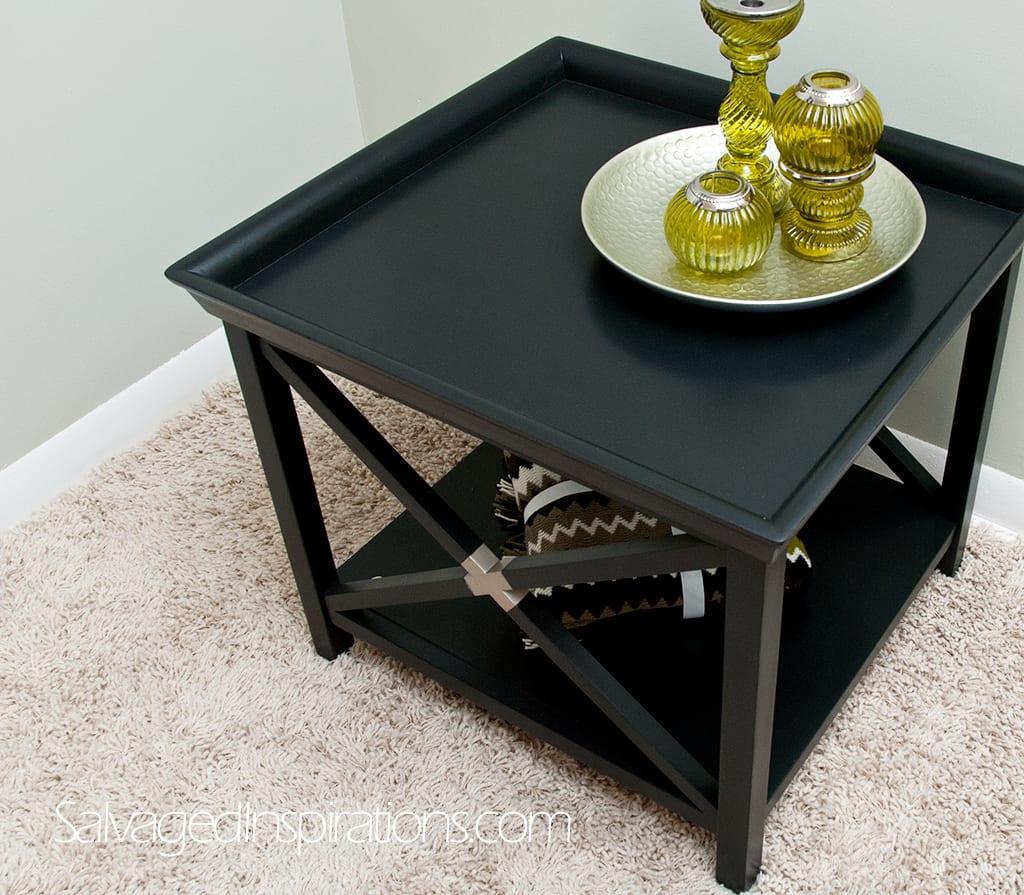
Because I was in a rush with my packing, holiday preparation yada-yada-yada (do people still say yada-yada 😉 ), I rushed to get this table staged, photographed, and posted to this blog. Take a look what happened. If you look closely, you’ll see exactly where the plate left its mark!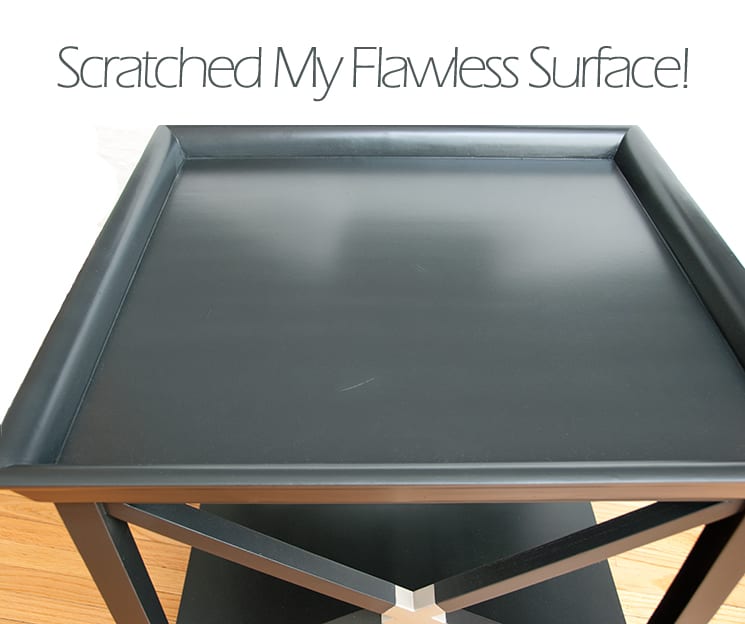
I’ve been painting furniture long enough to know that paint can feel DRY to the touch in as little as 1 or 2 hours, however CURE time usually takes 3-4 weeks. This is because PAINT DRY and PAINT CURE are two different things.
Paint “DRY” happens when the solvents evaporate from your paint coating leaving the paint feeling dry to the touch even though it is not 100% dry.
Paint “CURE” happens when your paint coating has reached it’s maximum hardness and is completely 100% dry.
When reading the label on your paint can, it will tell you the DRY time, not the CURE time. Through many mistakes just like my table above, I’ve learned it’s best to wait until furniture has CURED before staging and selling. Sometimes this isn’t possible. For instance, if a client wants their furniture asap, I always explain the repercussions of using the furniture before it has had time to cure.
How long does it take paint to dry and cure?
Water Based/Latex Paint ~ Dry Time 1-2 hours – Cure Time 21-30 days
Oil Based Paint ~ Dry Time 6-8 hours – Cure Time 3-7 days
Chalk Brand Paints ~ Dry Time 30-60 minutes – Cure time 30 days
Homemade Chalky Paint ~ Dry Time 30-60 minutes – Cure Time 21-30 days
Milk Paint ~ Dry Time 30 minutes – Cure time 30 days
Some factors which effect dry/cure time.
The thickness of your paint
The surface it’s painted on eg. wood/melamine/dry wall/concrete/canvas etc.
The sheen of the paint eg. flat/eggshell/satin/semi-gloss/high-gloss
The brand and type of paint eg. oil/latex/chalk/acrylic/milk paint
The color of the paint and tints used eg. longer drying time with dark colors
The overall condition of where it is left to dry eg. air flow/humidity/temperature
The number of coats applied
How to check if your paint is dry?
To check if your paint is dry, touch an inconspicuous area with your finger. If the paint is not tacky and feels dry to the touch, it is dry.
How to check if your paint is cured?
To check if your paint is cured, do the fingernail test. In an inconspicuous area, press your fingernail into the paint. If it leaves an indent (like my plate did…grrrr!!!) your paint is not fully cured. If no indent is visible and the surface is hard, your paint has cured.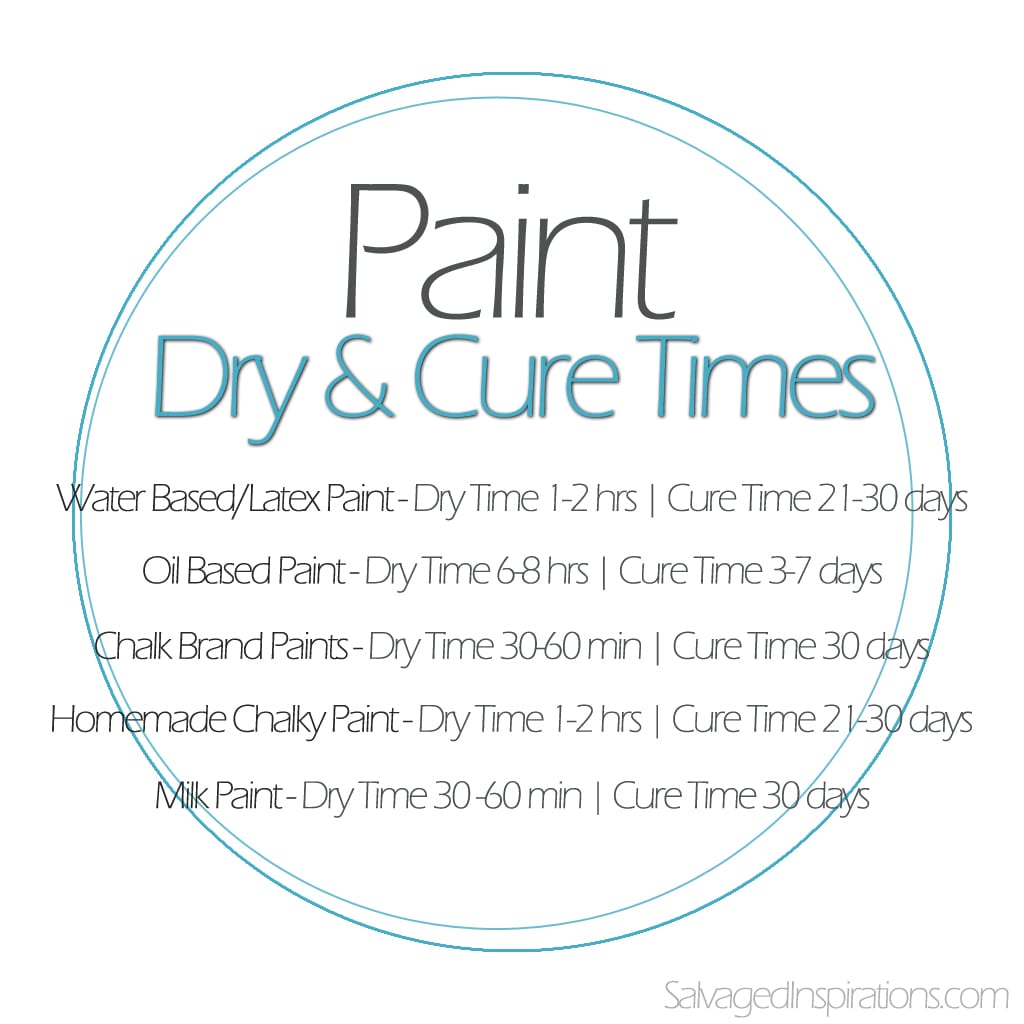
So do you think I should add P-A-T-I-E-N-C-E to my list of New Years Resolutions? {rolling my eyes and smiling}
I’d love to hear how long you wait for your paint to dry before using or selling your furniture. Don’t be shy… If you’ve had a similar experience, leave a comment! It will make me feel a whole lot better knowing I’m not the only one!
Enjoy your day!
 Hello again... I'm so happy you dropped by! Let's keep in touch! Follow me on social media or sign up for a dose of furniture painting inspiration and diy tutorials. :)
Hi Denise,
After painting my kitchen table and chairs, how long should I wait until i can sit on them and use them? I used chalk paint and stained the seats of the chairs and I also stained the top of my table.
Thanks for your help,
Sam
Hi Sam. You can usually get away with ‘light’ use within a few days of the paint being 100% dry. But as I mention above, there are numerous things that affect dry/cure time. To be perfectly safe, the recommended 21-30 days is recommended before regular day to day use. ie – hot plates, sharp objects etc.
I am painting plywood shelves. I primed them with Zinsser bin oil base primer then painted with Behr premium plus satin enamel (stain blocking paint and primer in one) I want to put Heavy use formula varathane oil based poly on top. My question is do I need to sand the paint if finish is lumpy before applying poly or will poly fill in roller marks.
For a professional looking finish – a light sanding will always make a huge difference Joanne. 🙂
Thanks for answering so quickly! I also noticed I forgot to ask how soon after painting can you sand the paint? If you sand too soon won’t it gum up the sandpaper? Thanks again
Yes, the paint should be 100% dry before sanding and this will depend on the paint’s dry time and other factors like humidity etc.
I am a total NEWBIE(!) to wood projects. I am building benches and putting waterbased poly on the sanded unfinished wood. Have used quality wood and several coats of poly. I like the results so far. With my last bench, I decided I’d like to try painting a color. Unfortunately, I decided this AFTER I’ve already applied a light coat of the water-based poly. Can this function as a primer under some enamel (or other? what’s best?) paint? (I have not sanded it yet, so it has a rough texture from the raised wood) OR should I just wait for the next bench and go buy some cheap white primer?
Paint will not adhere well to your water based poly Jeanna. A primer would be ideal to seal any bleed-through from tannin and provide the perfect base for a painted bench. 🙂
Hey there, I was under the impression acrylic took just a few days to cure but with your blog I realise I might be mistaken. Not sure what category acrylic falls into but it’s not oil and probably will take more than three days to cure. I don’t want to ruin my gauntlets/bracers. Hence why I ask, from your experience, how long should I wait between coats and before varnishing. Thanks.
Celinka, acrylic is a water based paint. Once acrylic paint is dry you can add another coat… usually a few hours. After my last coat of paint, I like to wait 24 hours of dry time (when possible) before top coating. Complete cure time is as above though.
Hi there,
I’m in the middle of refinishing table and chairs. I have primed and painted the chairs and table base semi gloss white latex paint. I’ve read that some sealers will turn the white yellow so I’m just wondering if Miniwax Polycrylic clear gloss will turn it yellow or not? I’d hate to have that happen after all the time that was put into this project! If it does, what do you suggest?
Thanks for your help!
Yes, Minwax Polycrylic can eventually turn a stark white piece slightly yellowish. Varathane sells a “NON YELLOWING” formula that I find works really well for white pieces. Any brand that indicates non-yellowing should work though.
I painted a wooden footstool for my granddaughter using craft acrylic paints. I purchased Minwax Polycrylic water based finish to put over the top. Does the paint need to be dry or cured before coating? When would it be able to be used?
The paint should be thoroughly DRY before top coating Mary Anne. After you’ve protected with Polycrylic, it can be used after it’s dried but I would wait the cure time before placing heavy items. Try the finger nail test in an inconspicuous area. 🙂
Hi there! So happy I found you : ) I just painted my craft room hardwood floors, Dutch Boy High Gloss Black for Floors/Porches. No mention of drying or curing times on the bucket and I couldn’t find anything on their website.
I plan on applying 4 coats of Varathane Water Based Polyurethane for Floors over the paint, and would like to know when I can do this.
I painted 3 coats of the latex paint I mentioned above and wonder how long I need to wait to apply the polyurethane.
Thanks so much for any help!!
Hi Lisa! A little challenging to say because I don’t know the environment you’re painting in. Humidity, temperature, air flow etc can all play a big factor. If conditions are ideal and timing is not an issue, I would wait 24-48 hrs for the 3 coats of latex paint to THOROUGHLY DRY before applying the Varathane. Your floor sounds amazing btw. 🙂
I was wondering how long I can wait before moving the pieces to an adjacent room? Would it be too risky to move them after 4 days? I really cannot wait 3 weeks as they are in my son’s room.
Hi Catherine! I move my freshly painted furniture all the time. I make sure it’s 100% dry (4 days is plenty!) and am super careful not to bump walls or wear jewelry or belt buckles that may damage the freshly painted surface.
I just finished painting & distressing 2 tabletops with Behr latex paint. I was thinking of using exterior water based poly (as I have it and it seems like it would be more durable that interior) to topcoat. do I need to wait 30 days for the paint itself to cure, or an I topcoat now & then wait for the tops to cure?
Laura… no need to wait 30 days before top coating. I always topcoat after my paint is thoroughly DRY, and then after I’ve sprayed all my coats, calculate my cure time from there. 🙂
Glad I found this post. Since I’ve made the mistake before, I knew I needed to let the paint on the newly painted desk cure before putting a slab of glass on top. I thought maybe I count get away with waiting two weeks, but now I can see that I will be better off waiting a full 30 days. After all the work, I don’t want to ruin it. Thanks for the info.
I been painting homes all my lift for 30 years I never herd of cure times I painted a book case with latex it wouldn’t stick I had to scape and sand all the paint off I then used bulls eye 1 2 3 all purpose latex primer I then put oil base paint on top of that yesterday I hope 7 days is long anough for them to put there stuff back on like a phone pitures and books with out it sticking .
i’ve bookmarked this page – thank you!
i have a question for you: i primed and then painted my kitchen counter top with rustoleum painter’s touch metallic paint. i’ve read everything i could on their website, and i can’t figure out what kind of paint this is (so i can then figure out cure time)! it needs mineral spirits/paint thinner to for clean up, so i thought it was oil-based. but it touch dried in 2-4 hours.
do you know what kind of paint this is?
Hmmm, I’m not sure wither Alpa but it sounds like it’s oil based if it requires mineral spirits/paint thinner for clean up. You could always call the manufacturer for a direct answer or if anyone reading this know..feel free to chime in. 🙂
Thank you for this post! I’m redoing our cabinets and do NOT want to re-redo them!
I painted a dresser with spray paint I primed it then sprayed black flat then 2 coats of high gloss spray paint do I need to poly it also?
I’m not exactly sure what type/brand of paint you used Sue but if your dresser is going to get a fair amount of use, cleaning, or hold weighty objects, I would poly to protect your paint finish.
I used rustoleum spray,what kind of poly would you use?
If you wanted to stick with the same brand Sue, Rustoleum sells various topcoats that are super compatible with their spray paints and also easy to spray and apply. 🙂
I purchased an older dresser and because I was unsure of how it was finished I primed it with SW Multi Purpose Latex Primer. 24 hours later It is dry to the touch but I can scratch it with my fingernail. Is it too soon to apply latex paint color?
Anne, I always read the SW label, and it tells me how many hours I should wait before re-coating. So long as your primer is not scratching OFF your dresser (this would mean it has not adhered properly and sanding the dresser would have been beneficial to provide some ‘tooth’ for your primer to grip onto) your okay to apply your latex paint. Once your piece is fully primed and painted, then allow proper cure time before placing any heavy objects on it. 🙂
I have a related question. I painted bedroom furniture with General Finishes Milk paint. After drying for 3-4 days it’s scratches with a light scratch of the fingernail. Unfortunately I know believe I listened to bad prep advice. All I did was scuff it up with a scotch pad and clean with 50/50 denatured alcohol and water . No primer. How can I fix it from this point?
Hi Rin! I’ve had this happen so I understand how frustrating it is after putting in all your work. The best way to remedy and get a 100% proof finish is to sand the paint down creating some tooth for the new paint to adhere to. You can also sand, prime, and then paint. The good news is once your piece is prepped properly, GF Milk Paint and topcoat are nice and durable.
Thank you!!! I was trying to find out how long a good drying time will take and you taught me it has to “cure.” Now my newly painted dresser and desk won’t have drawers stuck from using them too soon. You saved me a lot of grief (and touchup).
Hi Denise,
Great blog! I’m new to painting furniture and am learning which types of paint not to mix (mostly through mistakes). I used “Krylon ColorMaster™ Acrylic Latex Enamel” on an old dining set to keep outside. I painted a few coats but also wanted to protect it from weather and give it more of a clear protective gloss. I read that, “If you need to seal painted exterior furniture or decks, choose a compatible coating.” Now I’m seeing conflicting info on whether to use exterior poly spar, or Polyurethane or Polycrylic, or etc. Any advice? Thanks!
When I’ve painted outdoor furniture, I like to seal it with Varathane’s Water Based Diamond Outdoor Finish. I’ve even sealed Homemade Chalk/Mineral Paint with this great product and have never had any problems. You can read more on my painted outdoor furniture here.
My daughter bought a home and I am helping with the painting. There are shelves in the powder room I have painted which have glass to sit on the painted shelving. I was searching for the answer to “curing time”. Am I right in thinking we will have to wait 21-30 days to put the glass on the shelves? Thank you
For the paint to be fully cured and to be 100% sure the finish won’t be compromised.. YES. However, many people don’t or won’t wait the full cure time and all ends well. You can try the fingernail test (apply pressure in an inconspicuous area with your finger nail or real nail to see if it leaves a mark) but keep in mind if the paint is not 100% cured, it doesn’t get any air circulation under a piece of glass.
Thank you!
Thanks. I have been in touch with the paint company and so far no reply. I will spray a piece of scrap and see how long it takes to cure.
Pleasure…good luck with your project.
I am using british paints quick drying enamel out of an aerosol can to infill engraving on a brass plaque and the paint has to be cured before applying a clear finish.Does the quick drying aerosol paint have a shorter or longer cure time. Thanks
Hmmm.. I’ve never used British Paints John but my guess would be cure time would be the same as other paints. I have a quick drying primer (dries within 15min to the touch and can be re-coated in 45min) but cure time is the same. You can always try getting in touch with the manufacturer for specifics. Usually paint company’s have great customer service.
Hi, my boyfriend and I decided to rejuvenate some of our existing furniture for our new house. We chose Rust-Oleum Chalky finish furniture paint and applied the first coat yesterday. The tin says “Touch dry in 1 hour. Hard dry after 4 hours. Time to recoat: 4 hours. Coats required: 1 – 2 coats” However after leaving it all night in a warm room to dry. He has tried to apply a second coat and the wet second coat appears to pull the 1st coat with the brush and makes it lumpy. He is now wishing we’d left it with just one coat but I wonder if you could shed any light on why that would have happened? Since finding your site we now realise we should have perhaps left it 30 days or so. Any advise on how to fix the issue would be greatly received. Thank you 🙂
Victoria, it sounds like for whatever reason (moisture, grease, dirt, glossy surface, etc???) the first coat did not adhere properly. And you did everything correctly… you shouldn’t have to wait 30 days to re-coat if the manufacturer is indicating 4 hours.Unfortunately, the only way to properly fix the pulled off lumpy paint would be to strip, sand and repaint your piece. Cleaning with a TSP and then giving it a light sanding should do the trick. 🙂
Hi I have a question about paint curing that I hope you might help with. We have a coffee table we painted with Sico furniture paint which is a water-based interior alkyd emulsion paint. The coffee table is glass coffee table with a wood frame. There is a very thin edge of the wood frame that comes into contact with the glass. Will the paint cure under the glass or should we wait the full time before we put the glass top on?
The paint should cure under the glass however if you replace the glass too soon, it may ruin your finish. If you’re in a rush, you can check to make sure the table is thoroughly dry by using the fingernail test. If it’s leaving any sign of indents, wait to install the glass. Ideally, if you have time, waiting the full cure time is the best. 🙂
Thanks for this post! I just painted a table and sidevoard, and I was convinced I had done something wrong (even though I was meticulous)so cureing times makes sense. I cannot wait until it’s done, I’ve got so much decorating to do!
Thanks so much for helping out us novice furniture painters. I just painted a small table with homemade chalk paint. How long should I let it dry before waxing it? Do I need to let it cure first?
Thanks for your help.
Joan
I like to wait 24hrs before waxing a piece Joan. I allow it to fully dry before waxing but it does not need to be fully cured.
Holy crap, i didn’t know the cure time was 21-30 days for latex paint. This explains a lot . I don’t make furniture but mess around with outdoor yard cut outs . Well this explains a whole lot. I recently cut out and painted two turkeys for my neighbor and after two days I set them in his yard. When I went and set one of the turkey’s down I barely touched a rock with the turkey’s tail and it scraped the paint right off down to the primer. Man was I mad. I thought it was because I airbrushed it and didn’t have enough paint, but when I thought about it I had sprayed that sucker with 3 coats not thinned out. So I should’ve had enough paint on it, so I chalked it up to poor quality paint. Now I feel like a fool. Well good to know and lesson learned. Thanks
Glad this post was helpful Troy. And sorry about your turkey’s tail. Been there with a few projects, so I know how frustrating it is!
How can I protect a metal lamp I’m painting with acrylic paint, from scratches? Varnish may melt when the lamp is on..any other suggestions of what I can use that won’t melt with the heat of a bulb? (besides doing many coats of paint..)
Hi there Liza! The heat emitted from a bulb is usually not hot enough to melt off a topcoat. However, if you’re concerned, I would apply a few thin coats of paint and allow proper drying in between. Then use an outdoor polycrylic to seal/protect it.
I am painting a primered 30×30 tabletop (from marine plywood). I have painted the project with various waterbased acrylic/enamels. I am now “edging” the project with another waterbased acrylic/enamel paint (DecoArt Ameicana Gloss Enamel [DAG265]), but the bottle AND website does not give ANY information about HOW LONG TO WAIT BETWEEN ADDITIONAL COATS! Can you help?!!
(not asking for ya to come over & do it for me!)
Your insight is greatly appreciated! Thanks!!
I just looked it up and couldn’t find an exact time either Ray. Generally speaking, enamel paints are usually good for re-coat within 5-6 hours… and that’s being generous! Often you can re-coat in 1-2 hours. Factors that come into play are humidity, temperature, how thick/thin the coats of paint etc. Your project sounds great btw… and it’s not as fun or rewarding if you get someone to come over and do it for ya…lol. 😉
Hi there!
My husband just built me a craft table and we’ve painted the tabletop with Behr Ultra Premium Interior Satin Enamel in white (the storage/legs of the table are pre-finished cube shelves, so no paint). Do I need to seal with polyurethane or is an “enamel” good to go? (This is my first furniture painting project and I’m already terrified of the poly!). Thanks so much!
Jean
Enamel paints dry hard and durable so your enamel painted craft table is good to go Jean. And as a side note, no need to fear the poly… if you can paint, you can topcoat. 🙂
Thanks so much!!
Hello denise thanks for this knowledge.
I have a guitar, i’ve done the painting project but after 2weeks of hunging. One time I put into the bag, there are many dent mark.
Asking:
What paint I apply when I rework the painting?, fastest dry at cure?
Thanks…..
Add me in facebook liee_adamant@yahoo.com
May I ask what type of paint you painted your guitar with? if it was an oil based product, possibly it had not fully cured before putting into the bag. Water based products will dry and cure at a faster rate.
Bought a house in Jul and needed to do some touch-ups(i.e. nail holes, little dings). Owner left me the paint colours so in bathroom I patched, primed and tried to just touch-up rather than pain the whole wall feathering out paint but I notice that the colour is fine but the sheen is shinier where I touched-up. Should I leave it till its fully cured(it’s only been a week) to see if it’s improved or just paint the whole wall now?
This is a great questions Carol! Paint touch up can be finicky. Changes in temperature can cause touch-up paint to come out slightly lighter or darker than the original coat. Porous surfaces (particularly with gloss finishes) can absorb more of the paint and leave more or less of a sheen or shine. Alkyd touch-ups can require several weeks to cure while latex needs less time. And speaking of time, applying fresh touch-up paint to ‘old’ or ‘older’ paint can affect how well the two coats will blend together. If you’re in no rush, I would wait another week or two (and hope for the best) until the touch-up has thoroughly cured before deciding whether or not to paint the entire wall.
I have 2 toddlers that got ahold of sharpies ARG!! So my bright idea was to paint the door a darker color and yuck it turned out an ugly brown (i have only painted by color before lol) how long should/can i wait to repaint the door white or another color??
Kendra, you can re-paint your door within 24hrs of applying your first coat. If you read the paint manufacturers label, probably even sooner.. often you can re-coat after 3-6hrs. With the additional coat(s) of paint, it will be important to leave adequate dry/cure time though… especially with your toddlers running around with those Sharpies! 😉
My question is for painting metal. I have seen some metal that has been painted and I take the fingernail test to test the hardness of paint by pressing down on surface and moving fingernails up and down on surface trying to see if paint will scratch and the surface is so slick as glass that I cannot scratch the paint no mater how hard I try to. However I go and buy those spray cans of DTM (Direct To Metal) paint at Lowe’s or Home Depot or local auto parts place like Advance and spray paint a metal surface. After several months I can go and do the same fingernail test and I can scratch the paint down to the metal surface easily. What are the professionals and Manufacturers of equipment made of metal doing to create this slick as glass surface that your fingernails cannot scratch the surface no mater how hard you bare down onto surface with your fingernails trying to put a scratch in it to test? Are they using a hardener in paint? Or are they doing a process called powder coating? I want to paint a metal surface with the same results where my fingernails cannot scratch paint but don’t know if putting a hardener in paint will give me that “cannot scratch with fingernails slick as glass” surface. I don’t have the equipment to powder coat metal nor an oven big enough to put this large metal frame work in for baking after powder coating but wondering if I can get the same results by using hardeners. Any thoughts?
Hmmm, you’ve stumped me. I only paint small amounts of metal Danny. Basically furniture hardware, detailing etc, so I’m not sure I have the most thorough answer for you. Possibly a product like SEM Product Hardener and Gloss Enhancer may give you your desired results…and/or a High Performance Metal Primer before painting may be helpful for proper adhesion. Professional car painting/metal painting forums may have an abundance of info on other products available.
It’s probably powder coated not painted
I think I have ruined my oak kitchen table. I wanted to paint it entirely black. I sanded the table and applied latex semi-gloss paint. When it dried, some places looked glossy and almost wet, while others looked flat and dried; however, the table was entirely dry. Then I was told by Home Depot to apply a primer. I lightly sanded and did so. Repainted the table. The results were the same. It is driving me crazy that I have this inconsistency with the paint, especially noticeable when the lights are on. BTW, I also used different kinds of rollers thinking that was the issue. Should I hire someone to professionally sand down the top to the wood and start over? Really frustrating.
Hmmm… not sure Mary and I can see how frustrating that is! Could it possibly have been that the paint had been sitting for some time and it wasn’t properly mixed prior to painting? Or maybe the paint was not applied evenly therefore resulting in slightly different sheen? Were there any stains or grease spots on the table prior to painting? … I’m grasping here! I should think a sanding, a good primer, quality paint and an even application (taking care to maintain a wet edge) should remedy the problem. Feel free to let me know how it turns out.
I’ve learned a lot already about paint, but I’m baffled by a problem I’m having at work. I moved into a recently renovated office space, and I’m finding that a few months after the walls have been painted over, things (seemingly ANYTHING) that remain in contact with the wall for a few hours causes the paint to “melt” and stick to the surface of that thing, whether that thing happens to be fabric on a chair, papers, a cardboard box, a ceiling tile, or a wooden plank. When I pull the object away, it either leaves an imprint of it on the wall, or it actually pulls some pain off the wall in a small area where there was contact. I’m not sure what kind of paint it is, but for some reason I think it might be oil based. Any idea what on earth is going on and what I need to do to fix this? Thanks.
The stickiness of the paint on your office walls is referred to as ‘blocking’ and may be caused by a few things RK. The paint may have been applied too thick, it could be an extremely humid environment, or the layers of paint were not fully dry before applying a new coat. Aside from stripping and re-doing all the walls, you could try applying talcum powder on the surface (which may a little tricky on a wall?), cranking the heat in the office (possibly in the evening when the office is empty so everyone doesn’t break a sweat?) or use a de-humidifier and space heater to speed up the drying process. Usually time (sometimes a lot of time) will fix the problem. As a side note, this is most likely latex paint (oil paints don’t usually react this way). Super frustrating… and I hope it dries nicely for you.
I know this post is old but… I painted the kitchen w/latex primer and latex paint and 6 months later! my top sticks to it if I lean against the wall. I’ve been painting a long time and I’m shocked by this.
It’s my favorite primer Zinsser Bulls Eye and paint I have never used before, Murphy Brothers’. We live in Seattle. I blame it on no air conditioning. Because they think “we don’t need air conditioning, it’s only hot a few (months) days!!”
Thanks for a great post. I just built a kitchen table with farmhouse benches and I distressed them with glaze. Well I decided to paint the tops of the benches and table with latex and was wondering how long I needed so I don’t nick my creation and mess it up. I am sealing it with polycrylic. Do you think if I just rock it with a table cloth for a couple weeks until it cures the table cloth will provide enough cushion for normal use of plates and stuff?
PJ, I get it… I would be tempted to “just rock it with a table cloth for a couple of weeks” until is cured to! 🙂 But seeing as you put all this time and effort into re-styling this farmhouse table/benches, the SAFE bet is to let it dry and cure fully (3-4 weeks) before placing a table cloth or hot meal on it.
Can you use Polycrylic (water based) over oil based paint? I used Rust-Oleum Bright Coat Metallic Finish spray paint on a dresser and I want a hard finish because of the wear and tear on the dresser. I don’t want to use polyurethane because it yellows. Some people say that you cannot use polycylic over oil based paint because it will crack and peel. Any ideas?
I believe you can. Here’s a quote I found from Minwax…. “Minwax Polycrylic® may be applied over latex and oil-based paints and well-bonded wall coverings.”
For the first time in 67 years, I have my very own ‘first apartment’. Just me, my cute little dog, a few antique things (so I’ll have something older than me in my home), Pinterest, and a landlord who allows me to paint whatever I want to paint. Before tackling the out-dated kitchen cabinets. I started with an old table and acrylic-latex paint for practice.
It was beautiful, a smooth creamy dream with sagey green accents. Then I put a lamp on it – and scratched it. I painted it again and scratched it again. I painted it again, and insulted the paint with some language I learned in the Army.
I hereby formally and publicly apologize to my can of paint for all the mean things I said to it!
Thank you for teaching this old dog a new trick. Sit-stay for thirty days! Go clean the windows or get started on the cabinets. Something, anything other than popping things on a freshly painted table.
Thanks for sharing Mae… and thanks for the laugh! I bet I could have given your ‘Army Language’ a run-for-the-money when I ruined my finish! 😉
So I just painted my kitchen cabinets. I used behr alkyd latex semi gloss in a deep base. I had it tinted to a black. I sanded the cabinets very well then used a deglosser and primed. I put on 2 coats of paint waiting 24 hours between coats. I finished the last coat 4 days ago. The cabinets doors still feel sticky. I feel like they shouldn’t be sticky anymore. Should I wait longer or start sanding and start all over? I’m really dissapointed in the outcome.
Please help!
It sounds like you did everything perfectly Michelle. Were you/are you painting in a high humidity environment? Sometimes extreme temperatures and high humidity will prevent paint from drying and curing properly.
I am in Illinois. It is pretty humid out right now. However, I have been painting indoors with the air conditioning on as well as a dehumidifier in the room I am working.
Hmmm… then I’m stumped Michelle? The only other thing I can think of is that the paint was applied too thick and didn’t have ample time to dry in between coats. If this is the case, time will fix it but it could take a few more days to completely dry and then a few more weeks to totally cure. Rather than start from scratch, a little time and patience should do the trick!
Ok thanks for your help! I’ll wait a little longer!
Thanks!
I just finished painting a dresser with SW latex enamel. I have decided to cross my fingers and not apply a poly over it. Neither the can or the website gives dry time or cure time, just a recoat time of four hours. I painted the sides of the drawers and the tops of the inside edges. I’m trying to figure out how long I need to wait before assembling the dresser and putting it to use. I’m willing to wait a month to put anything on top, but I have it’s contents in buckets on the living room floor right now which I’d very much like put away.
This is so helpful, thank you! I’ve painted many times with latex and think I have my curing system figured out, but just did my first piece with a glossy oil based enamel and wasn’t sure how long to let it cure.
What’s difference between hard dry & touch dry ?
Touch Dry can also be called “dry-to-the-touch”. The paint has had a few hours to dry and if you touch it, it feels dry. At this point a second coat can be applied. The dry time and second coat application is always indicated on the instructions on your paint can. Hard Dry is the “cure” time. The paint has had time to fully “harden and set” which usually takes a few weeks.
I used Behr acrylic paint on some dining room chairs. It says self-sealing. Do I trust this or should I add a coat or two of polyurethane?
Alisa, if you’ve put in all the time and effort to re-style your chairs and make them beautiful again, you probably want to keep them looking perfect for many years to come. For high traffic dining room chairs, I would add a few coats of poly.
Is there one paint bland that is better than another for painting furniture. Is satin enamel good
Yes enamel/acrylic is great! Cures stronger & harder than regular latex.
Hi Denise. thank you for your post! We just finished painting our kitchen cabinets with Latex paint and want to apply polycrylic to them. Should we wait for them to cure? or go ahead and apply once it is dry to the touch?
Thanks for any help!
Chris, it’s just fine to apply your polycrylic once your paint has fully dried. I would just be mindful/gentle with the cabinets for 3-4 weeks while they are curing.
I’m glad to find this article and website! I have a question but it’s not about painted furniture… We are moving into our first home and painted the closets (so much cleaner now!) How long do I need to wait to put things in the closets? Is just waiting the dry time going to be ok?
Congrats on your 1st home Alie! If you’re just hanging clothes in the freshly painted closet I’m sure the dry time will be sufficient because nothing heavy is directly on the paint. If you have a freshly painted shelf(s) in your closet and are thinking of storing something heavy on it, it may be ‘safer’ to wait until the paint is cured.
I’m painting a dresser with blck latex satin paint. When I tried to put polycrylic on it – it left shiny and dull spots and looked terrible. Am I doing something wrong? Does something painted with latex satin really need to be sealed, as long as I let it cure enough before putting anything on it? I have sanded it down, re-primed it with oil based primer and painted it again. I don’t want to mess it up a second time, so any help you could give would really be appreciated. I’m at my wits end LOL
Ohhh Pat… I know how frustrating that can be! Yes, when painting furniture with latex, it’s advisable to seal/protect. If you were to use an enamel/acrylic paint which dries much harder than latex, then it’s not needed in all cases. Is it possible your polycrylic was not applied evenly? I’m asking because the exact same thing happened to me with a Wipe-on-Poly. I love the stuff, but it never seems to give me a flawless even coverage on large surfaces.
Well, I thought I applied it evenly – I used a purdy brush. I guess I will try it again – might have to use three or four coats to get it just right. I heard painting with black harder to get good sealing coverage.
That’s correct Pat. Black can show more especially if there is a shine! Good luck… I’m wishing you success! 🙂
What you’re seeing are called lap marks. This happens when you don’t maintain a wet edge and go over an area that has already started to dry. I find that it’s best to start on the right side of a piece (like a table top) and work to the left with long strokes from top to bottom (and never back up from bottom to top) lifting my brush/rag at the bottom and returning to the top to wipe down again while overlapping 1/3 of what I’ve just applied (this is your wet edge). Also, shine a light on your work surface so you can see the strokes you’re making and quickly fix any misses you make.
I remolding my cabinets in using Acrylic Latex Paint . I did use primer . The best paint . The cabinets was very dry . I I did panels then put trim in oanels and it all needs a final coAt. One month later. In just now getting to final coat is this to many coats . Am I messing up the job ? ThBk you for your help
So if I’m understanding correctly Barb, 1 coat of primer and then 2 or 3 coats of paint plus a topcoat? This is quite standard and should cure nicely. 🙂
Hi. I have a question because I may have messed up my kitchen table?!? I used an oil based primer (one coat), two thin coats of eggshell latex in light gray, and then two thin coats of poly acrylic on top. I let them dry between coats… But will the oil cure underneath the latex and poly?
Megan, if you waited sufficient dry time between each coat of product (ie: instructions on the can) you should have no problem at all. But please…learn from my mistake… beware of putting anything heavy-duty on your table before it does cure! 😉
Not recommended to paint latex over oil based paint, but you can do the opposite. If you paint oilpaint under latex, it will take much much longer to cure if it does, but will breakup over handling eventually. I’m a paint artist and this is what I’ve learned even if your canvas is furniture, but if it does cure in your manner, then you might want to protect coat with polyurethane. I recommend doing it right the first time in.
Thanks Denise for all your research…this is great to know and I will have to save this info. I noticed when I stained the top of a piece of furniture and used fast drying polyurethane, that I had no problems with putting items on it after about 3 days. Nothing ever sticks to it and it still has the original shine for almost two years now.
I am so grateful to have read this post. I am new at furniture makeovers and would not have learned this very valuable information. Thank you so much.
Regards,
Blondie
Where did you find these “Cure” times posted?
Just curious…
Often Brand Name Paints eg Annie Sloan will list dry and cure times on their websites anniesloanunfolded.com/faqs. And I’ll admit… I’m a bonafide geek/book-worm Melissa..lol. I do A LOT of reading and researching on Paint Forums, posts from other experienced bloggers/furniture painters, and probably most importantly, I gain knowledge from my own mistakes and personal experience. I’m also very lucky to have some extraordinary readers who email/leave comments and share their knowledge.
I painted my kitchen cabinets a couple days ago. They are still sticky and where I touched them it has left a dull spot. I used a semi gloss and they are very dark brown. Will the dull spot go away after they are fully curred?
Lisa, when cabinets are handled when not fully dry, it’s easy to leave finger prints or lotion/grease residue from hands when handling. Unfortunately, these dull spots do not usually go away once cured, but can be easily retouched if still visible.